PROSTest®
What is Prostate Cancer?
Prostate cancer is a malignancy originating from the prostate gland, primarily as adenocarcinomas. While it often starts localized, it can invade surrounding tissues and commonly metastasizes to lymph nodes and bones, leading to significant health issues like pain and fractures.
Incidence & Prevalence
Prostate cancer (PCa) is the most frequently diagnosed cancer in men in the USA, excluding skin cancer, and ranks second globally after lung cancer. In 2021, about 248,530 new cases were diagnosed in the USA. PCa occurs twice as frequently in Veterans, possibly due to exposure to Agent Orange. Currently, over 3 million men in the USA live with a PCa diagnosis, with a lifetime risk of about 1 in 8.
Risk Factors
Risk factors include age (60% of cases are in men aged 65+), race (African American men have the highest rates), and family history of the disease. Environmental and lifestyle factors, such as diet and obesity, also play significant roles. Global incidence varies, with higher rates in developed regions.
Diagnosis & Unmet Needs
Prostate cancer diagnosis typically begins with PSA testing and digital rectal exams. While PSA testing is valuable, concerns about overdiagnosis and treatment exist. A definitive diagnosis requires a biopsy. Key unmet needs include improving early detection, identifying who requires biopsies, and developing effective non-invasive diagnostic tools.
Patient Management
Treatment varies by stage, with options including surgery, radiation, androgen deprivation therapy, and chemotherapy. Prognosis depends on multiple factors, with localized PCa having a nearly 100% 5-year survival rate, while advanced disease has a 31% survival rate.
What is PROSTest?®
The PROSTest® is an innovative liquid biopsy assay using machine learning to analyze mRNA expression across 27 cancer-associated genes and 3 reference genes.
1 mL of blood is collected in our proprietary tube, and 0.2 mL is used for RNA extraction and RT-PCR analysis. The resulting data produces a score from 0-100, with a cutoff of 50 for positive/negative results. Exact scores enable monitoring for minimal residual disease (MRD) and recurrence.
Why Choose WREN’s PROSTest?®
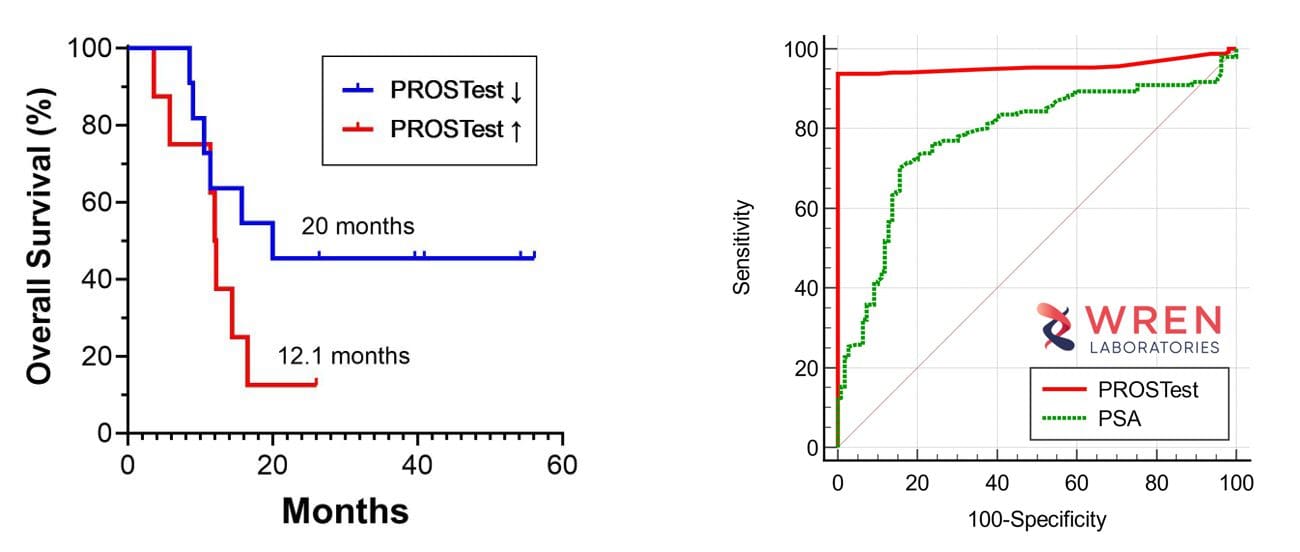
The PROSTest® is analytically validated and has demonstrated clinical value in multiple third-party studies. It boasts an analytical accuracy of 93% and precision between 98.8% and 99.2%, with the ability to detect as few as 2 cells/mL-RNA equivalent.
This test serves as both a diagnostic and prognostic biomarker and is useful for monitoring patients after surgery, chemotherapy, and radioligand therapies for minimal residual disease (MRD) or recurrence.

Diagnosis
A high PROSTest® score indicates a 93% likelihood of prostate cancer, while a low score suggests a 90% chance of not having the disease.

Patient Monitoring
Increased scores in serial samples can detect MRD or tumor recurrence in 93% of cases, while decreased scores indicate drug efficacy in 90%.

Prognosis
Elevated scores correlate with a poorer prognosis and shorter overall survival.